
When Art Becomes a Family Story

Updated: Dec 18, 2025

December 18, 2025
Some artists arrive at their style knowing exactly where they’re headed. Others discover it layer by layer—following curiosity, saying yes to new ideas, and letting the work evolve naturally. Vanessa Spittler’s journey has very much been the latter.

Vanessa’s professional art journey began right here on the Island. In 2020, she started showing her work at Padre Island Art Gallery, stepping into the art world during a time when many were rethinking direction and rediscovering creativity. What began as an exploration—learning, experimenting, saying yes to possibility—quickly turned into momentum, opening the door to what came next.
In just five short years, Vanessa has built a beautiful new career in art. Her work has grown not only in technique, but in confidence and range—expanding from fluid pours to layered paintings, surfboard collaborations, and now into deeply personal, family-driven projects.
Many people first came to know Vanessa through her pour art—the beautiful cells, rich movement, and unmistakable depth she creates using a proprietary formula she’s developed over time. Her pour artwork is vibrant and full of motion, rooted in experimentation and a willingness to let the process lead the way.


Beyond the Pour—Learning the Art of Gyotaku
Vanessa didn’t stop at pouring paint. As her confidence grew, she began painting on top of her pour art—adding detail and intention to those expressive backgrounds. That natural evolution eventually carried her work onto surfboards, including early board pieces created on those of the late surfer and artist John Olvey—work that holds special meaning for many on the Island. This opened the door to even more creative collaborations.

Some of those collaborations include Catherine McNew’s turtles layered onto Vanessa’s pours, and surfboard pieces where Vanessa created the poured backgrounds and Dinah Bowman applied her gyotaku fish prints on top. Each collaboration brought something new while still honoring the original foundation. The result is work that feels both collaborative and cohesive, with every piece telling more than one story.
It was through her collaborative process that Vanessa became interested in gyotaku—the traditional Japanese art of fish printing. I spoke briefly with Dinah, who shared some insight into the technique and mentioned how much she’s enjoyed working with Vanessa. That introduction opened the door for Vanessa to explore the ancient process herself, eventually making it her own.
Gyotaku, which translates to “fish rubbing,” is a traditional Japanese printmaking technique with roots that stretch back centuries. While it became widely documented in Japan during the mid-1800's or the Edo period, many believe the practice evolved from even earlier traditions of rubbing and printmaking used to record and honor important moments.
It has since evolved into a respected art form—one that balances precision with reverence for the subject.
The process begins with the fish itself. After carefully cleaning and preparing it, the surface is gently inked or painted—often by hand—making sure the pigment settles into every scale, fin, and contour. Too much ink can blur the details; too little, and the print loses its depth. It’s a delicate balance that comes only with practice.
Once the fish is inked, a sheet of rice paper is carefully laid over the surface. Using fingertips, soft tools, or gentle pressure, the artist presses the paper down, slowly revealing the fish’s natural texture beneath. The paper picks up every ridge and line—the story written into the body of the fish itself. When the paper is lifted away, what remains is a beautifully detailed impression, both raw and elegant.
Vanessa often adds subtle hand-painted details after the print is pulled, enhancing the eye or fins, or introducing soft washes of color. The result is not just a likeness of the fish, but a record of a moment—where it was caught, who caught it, and why it mattered.
There’s no rushing the process. Each step requires patience, respect, and intention—and that care shows in the finished piece. It’s art rooted in tradition, memory, and connection… which feels perfectly aligned with the way Vanessa approaches her work.
Around the same time she was learning the process, Vanessa found a deeply personal reason to continue working in gyotaku. Her husband, Chris, a lifelong fisherman, returned home one day with a trophy-size catch and asked Vanessa to document it in a meaningful way. While the technique wasn’t easy at first, Vanessa fell in love with the process. Using rice paper, ink, and paint, she began capturing not just the fish, but the memory of the moment it was caught.

Creativity Runs in the Family
Vanessa's husband, Chris, who works in the oil filter industry, also carries a creative spark of his own. During downtime, he began sketching ideas that eventually found their way onto surfboards. In carving those boards, he discovered a medium that continues to inspire him.
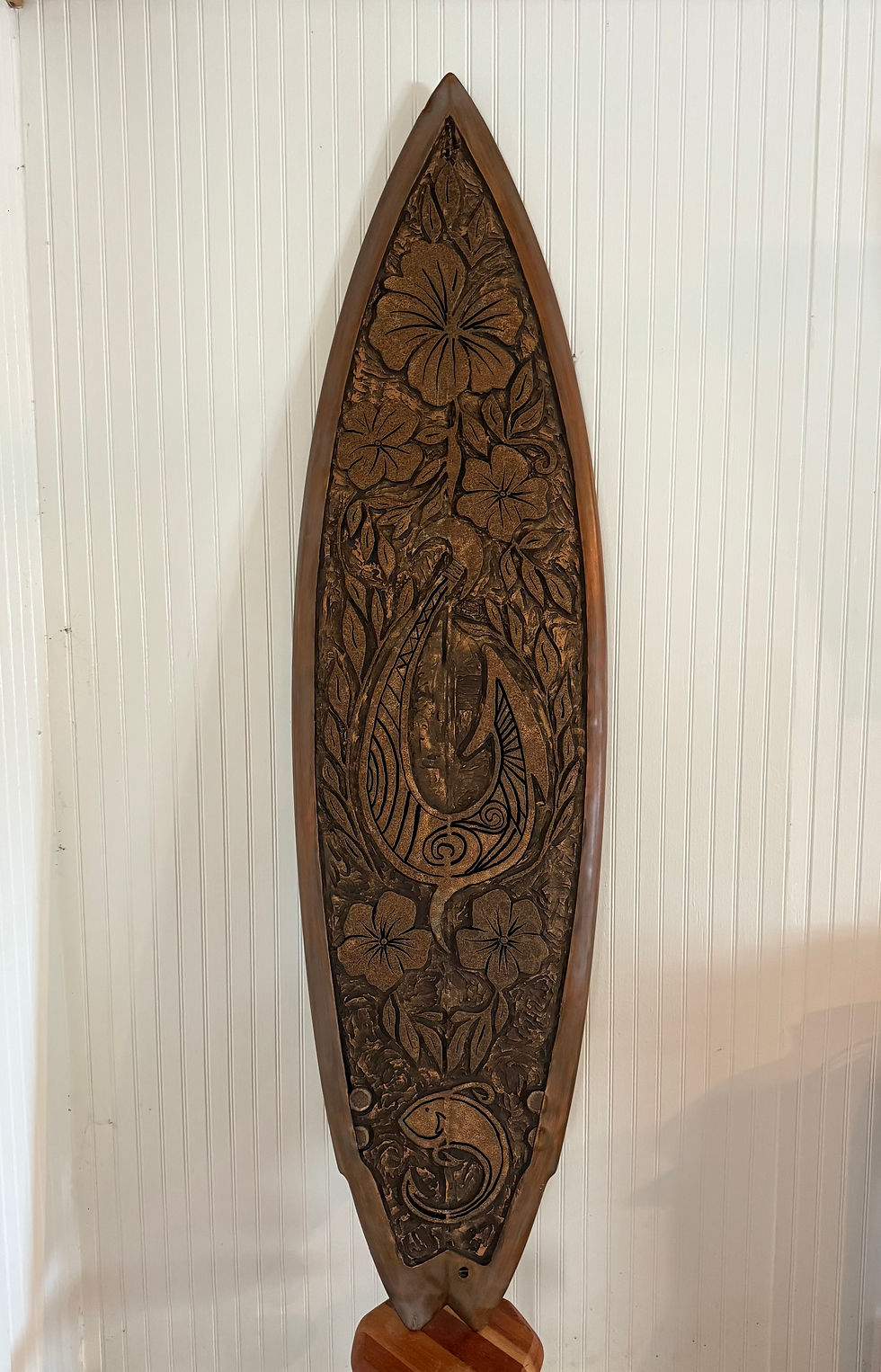
Vanessa paints the carved boards, transforming them into striking, one-of-a-kind pieces that feel both sculptural and alive.
Their daughter, Kayci, who studied art in college and has surfed on the Island since childhood, naturally gravitated toward coastal-inspired painting and surfboard carving as well. What began as individual creative paths has grown into a shared family passion—built on encouragement, experimentation, and learning together.

For the Spittler family, art isn’t just something that hangs on a wall—it’s something that brings them together. Vanessa hopes to be a positive influence for her daughters, showing them that with determination, curiosity, and heart, anything is possible.
It has truly been my pleasure to watch Vanessa grow—and one of the greatest rewards of what I do. Seeing that growth turn into a shared family story makes it even sweeter. Vanessa’s work continues to evolve, and I have no doubt the best chapters are still ahead. From her early pour art to being open to suggestions and trying everything that sparked her interest, Vanessa has stepped confidently into new creative territory. It’s that openness that has led her work into wonderful new spaces.
Where You Can Find Vanessa's Work
Today, Vanessa’s work—and her collaborative pieces—can be found at:
Evoke Studio & Gifts
Black Sheep Bistro
Cactus Flower Interiors – South Padre Island
Lisa Mayo Interiors & Lifestyle Boutique – Port Aransas
Coffee Waves – Port Aransas
Rockport Center for the Arts
Moon Over Water Art Gallery – Rockport
Bowman Design & Framing – Portland
Corpus Christi Art Center
Lazy Beach Brewery – Downtown & Southside
Barry Brown Clay Studio
Nueces Brewery
If you’re on the Island, pop into Evoke Studio & Gifts to see Kayci’s carved surfboard, some of Vanessa’s latest gyotaku prints, and a particularly special piece—a relief print of ink on canvas taken from Chris’s carved board shown in the photo above. Together, the work reflects a creative journey shaped by collaboration, curiosity, and family. I’m proud to represent this talented family and their work in my gallery.
The Art of Island Life will return next week with more coastal stories and community inspiration. Have a holiday tradition or memory you’d like to share? I’d love to hear from you at contact@melissamitchellart.com

Evoke Studio & Gifts
14646 Compass Street, Suite 10
The Island—Corpus Christi, Texas 78418
Hours: Tuesday-Thursday: 11a-4p, Friday & Saturday: 12p-4p, Closed Sunday & Monday
After-hours private shopping appointments may be arranged upon request, based on schedule availability.


Comments